Revisiting Using Sporting Memories to Tackle Dementia During the 2026 FIFA World Cup
The PsychPod Magazine | Brain & Science
Several years ago, I began exploring a question that continues to shape how I think about brain health, memory, and dementia care.
Could emotionally meaningful sporting experiences help preserve identity, encourage conversation, and strengthen social connection for individuals living with neurodegenerative diseases?
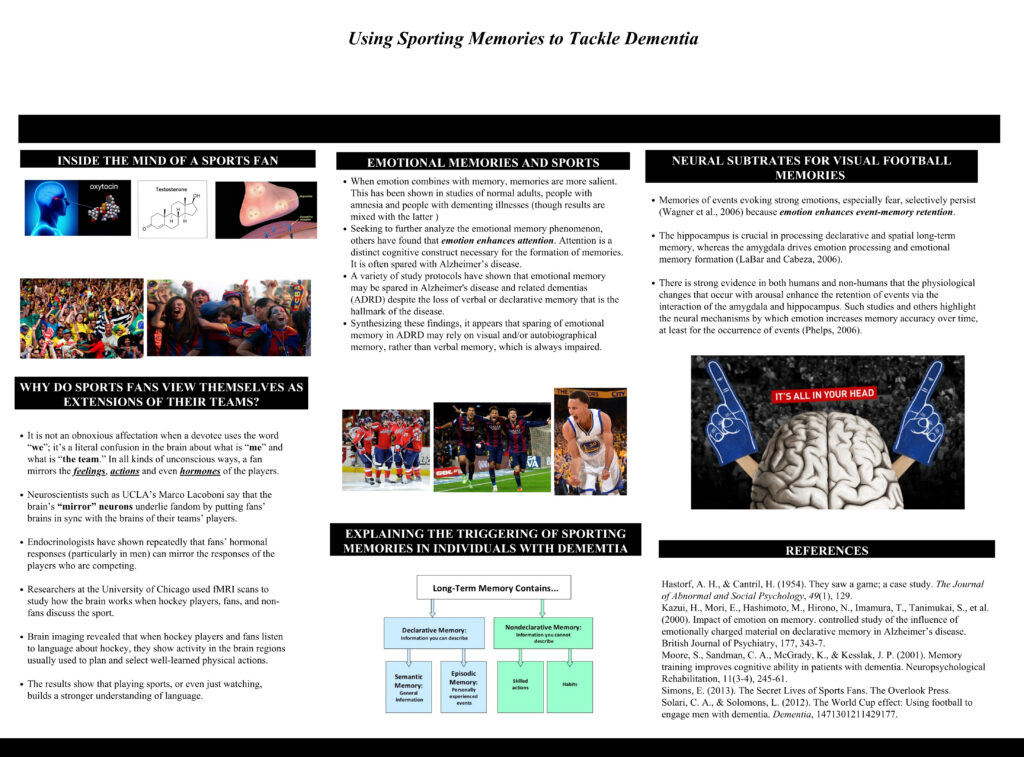
That question became the foundation of a research project titled Using Sporting Memories to Tackle Dementia. The project explored how football and other meaningful sporting experiences could serve as powerful reminders of family traditions, personal identity, community, and life’s defining moments. While football cannot prevent or cure dementia, emotionally meaningful sporting memories may provide valuable opportunities for reminiscence, person-centered engagement, and social connection.
Watching the 2026 FIFA World Cup unfold brought this project back into focus.
Throughout the tournament, millions of people experienced moments that extended far beyond football. Families gathered across generations. Friends celebrated together. Entire stadiums sang in unison. Complete strangers embraced after dramatic goals. Around the world, people were not simply watching matches.
They were creating memories.
From Norway’s unforgettable Viking Row led by Erling Haaland, to Lamine Yamal dazzling supporters with extraordinary maturity beyond his years, Jude Bellingham inspiring thousands of England supporters to sing “Hey Jude,” Vhozina’s remarkable saves, Gilberto Mora making history as one of the youngest players to compete on football’s biggest stage, and Lionel Messi and Cristiano Ronaldo continuing to inspire generations, the tournament reminded us that football creates experiences capable of lasting a lifetime.
Revisiting this project during the World Cup served as a reminder that football has the remarkable ability to bring together emotion, identity, culture, and memory in ways that few experiences can.
From a neuropsychological perspective, these emotionally meaningful moments provide a compelling example of how memory, emotion, identity, and social connection intersect throughout the lifespan.
More Than a Game
Long after the final whistle blows and the confetti settles, what remains?
Not just the score.
Not just the trophy.
People remember the roar of the crowd.
The songs echoing throughout the stadium.
The tears after heartbreak.
The embraces between complete strangers.
The celebrations that united millions of people across continents.
For many, football becomes a timeline of life itself.
People remember where they watched the match.
Who sat beside them.
The parent who introduced them to the game.
The grandparent who never missed a World Cup.
The sibling who celebrated every goal.
The traditions that transformed ninety minutes into memories lasting decades.
Football is often described as the world’s game, yet its significance extends far beyond the pitch.
It becomes part of family traditions.
Part of cultural identity.
Part of lifelong friendships.
Part of personal history.
Football becomes woven into who we are.
Every World Cup creates unforgettable moments.
Some become legendary because of extraordinary football.
Others become unforgettable because of the emotions attached to them.
The 2026 FIFA World Cup reminded the world why football occupies such an extraordinary place within human culture.
Millions watched together.
Families reunited.
Communities gathered in public squares.
Entire nations paused.
Strangers fell in love.
The tournament produced moments that supporters will likely remember for years to come.
Norway’s remarkable World Cup journey, led by Erling Haaland, inspired supporters around the world while the Viking Row celebration quickly became one of the defining images of the tournament.
Lamine Yamal continued to captivate football fans with his creativity, confidence, and maturity beyond his years. Watching one of football’s brightest young stars perform on the world’s biggest stage became another unforgettable chapter in World Cup history and a reminder that every generation discovers new heroes.
Jude Bellingham emerged as one of the tournament’s defining stars. His performances inspired England supporters, while thousands of voices singing “Hey Jude” transformed stadiums into a shared emotional experience. The song became more than a tribute to a player. It became part of the emotional soundtrack of the tournament.
Goalkeeper Vhozina’s remarkable saves demonstrated how one extraordinary performance can become permanently associated with a World Cup.
Gilberto Mora made history as one of the youngest players ever to compete on football’s biggest stage, inspiring countless young supporters and reminding the football world that extraordinary talent can emerge at any age.
Lionel Messi and Cristiano Ronaldo once again reminded football fans why greatness extends beyond records and trophies. For many supporters, watching two of football’s most influential players compete on the world’s biggest stage represented another chapter in a story they have followed for nearly two decades.
Beyond the football itself were the celebrations.
Families gathered across generations.
Friends embraced complete strangers after dramatic goals.
Children celebrated beside grandparents.
Entire communities came together in homes, stadiums, and public squares.
People cried tears of joy.
Others experienced heartbreak.
Many celebrated with complete strangers who, for a few unforgettable moments, felt like family.
These moments became memorable not simply because they happened during a World Cup.
They became memorable because of how they made people feel.
Years from now, many supporters may not remember every statistic from the tournament.
They will remember exactly where they were.
The Neuropsychology of Football
From a neuropsychological perspective, football offers far more than entertainment. It provides a remarkable example of how multiple brain systems work together to create meaningful experiences that can remain with us for decades.
Memory is not a single process.
The brain continuously encodes, stores, and retrieves information through interconnected systems that allow us to remember facts, recognize faces, develop skills, recall personal experiences, and build a sense of identity.
Among these systems, autobiographical memory plays an especially important role.
Autobiographical memory consists of the experiences that make each person’s life uniquely their own. It includes birthdays, graduations, weddings, vacations, childhood homes, meaningful relationships, personal achievements, and defining life experiences.
Football frequently becomes part of this personal history.
Unlike memorizing statistics or final scores, football memories are emotionally meaningful. They involve family, friends, music, movement, anticipation, celebration, disappointment, hope, belonging, and the communities with whom those experiences are shared.
The sights, sounds, and emotions surrounding a football match create a rich sensory experience. The colors of a national flag, the sound of supporters singing together, the whistle that begins the match, the eruption of a crowd after a goal, and even the familiar voice of a commentator become cues that can later trigger vivid autobiographical memories.
People rarely remember only the goal.
They remember the experience surrounding it.
Football reminds us that memory is rarely built from information alone.
It is built from emotion, relationships, and meaning.
Emotion, Attention, and Memory
Emotion influences attention.
Attention influences memory.
When an experience carries emotional significance, the brain naturally allocates greater attention to it. This increased attention contributes to stronger encoding of the experience and often makes it more memorable than routine daily events.
Brain structures such as the amygdala and hippocampus play important roles during emotionally meaningful experiences. The amygdala contributes to emotional processing, while the hippocampus plays a central role in forming new memories. Together, these structures help explain why emotionally significant experiences frequently become lasting autobiographical memories.
Emotion does not guarantee perfect memory.
Rather, emotionally meaningful experiences often become personally significant because they are associated with people, places, traditions, relationships, and life events that shape identity.
This is one reason many supporters can vividly recall where they watched a historic World Cup match years later. They may remember the room, the people around them, the sound of the crowd, the celebrations after the final whistle, and the emotions they experienced long after they have forgotten the final score.
Football demonstrates that some of our strongest memories are not built around statistics.
They are built around experiences.
Mirror Neurons and Experiencing the Match
One of the most fascinating aspects of football is that supporters often feel as though they are participating in the match despite never stepping onto the pitch.
Research in neuroscience has shown that observing another person’s actions can activate some of the same neural networks involved in performing those actions ourselves. This phenomenon has been linked to what is commonly referred to as the mirror neuron system.
This may help explain why supporters instinctively celebrate a goal by throwing their arms into the air.
Why they lean forward during a penalty kick.
Why they gasp after a missed opportunity.
Why they instinctively mimic a player’s celebration.
The brain is not simply observing.
It is, in many ways, experiencing the action alongside the players.
This shared neural and emotional engagement may contribute to why football becomes such a powerful source of autobiographical memories.
The Team as an Extension of the Self
Another fascinating psychological phenomenon occurs when supporters stop referring to a team as “they” and begin referring to it as “we.”
“We won.”
“We’re going to the final.”
“We played well today.”
These phrases reflect more than everyday language.
They reflect identity.
Psychological research has long demonstrated that people derive part of their identity from the groups to which they belong. National teams, local clubs, and football communities become extensions of the self.
Victories feel personal.
Defeats feel personal.
Supporters experience pride, disappointment, excitement, and hope as though they themselves had stepped onto the pitch.
This powerful sense of identification helps explain why football can influence mood, strengthen social bonds, and create memories that remain vivid throughout life.
Football becomes more than a sport.
It becomes part of one’s identity.
Dopamine, Anticipation, and the Beautiful Game
Football is filled with uncertainty.
A last-minute goal.
A penalty shootout.
A dramatic comeback.
An unexpected upset.
These moments engage the brain’s reward system.
Dopamine, a neurotransmitter involved in motivation, learning, and reward prediction, increases during moments of anticipation and unexpected positive outcomes.
Supporters often describe being “on the edge of their seat.”
From a neuropsychological perspective, this anticipation is part of what makes football so emotionally compelling.
The brain is constantly making predictions about what might happen next.
When expectations are exceeded, the emotional impact becomes even stronger.
These emotionally charged moments are more likely to become lasting memories.
Music, Memory, and the Soundtrack of the World Cup
Some memories begin with a photograph.
Others begin with a song.
Music is one of the most powerful cues for autobiographical memory.
A familiar melody can transport someone back to a specific place, time, and emotional experience within seconds.
During the 2026 FIFA World Cup, England supporters transformed “Hey Jude” into one of the tournament’s defining moments. The song became more than entertainment.
It became part of the tournament’s identity.
Years from now, hearing those opening notes may immediately remind supporters of Jude Bellingham, England’s remarkable performances, the atmosphere inside the stadium, and the people with whom they shared those experiences.
This relationship between music and memory is one reason familiar songs are frequently incorporated into person-centered dementia care and reminiscence-based interventions.
Music often remains emotionally meaningful even when other forms of memory become more difficult to access.
Collective Memory and Emotional Contagion
The World Cup creates something relatively rare.
It creates collective memory.
Millions of people witness the same event while simultaneously creating their own personal memories.
Every supporter experiences the match differently.
Some watch from the stadium.
Others gather with family.
Some celebrate in crowded city squares.
Others watch quietly from home.
Although each experience is unique, everyone becomes connected through the same moment in history.
Emotion also spreads throughout these environments.
One supporter celebrates.
Soon an entire section erupts.
Within moments, an entire stadium is singing, cheering, laughing, or grieving together.
Psychologists often describe this process as emotional contagion.
Human emotions are remarkably social.
We naturally influence one another through facial expressions, body language, voice, and shared experiences.
This collective emotional experience contributes to why football remains one of the world’s most memorable sporting events.
Supporters do not simply remember the match.
They remember being part of something larger than themselves.
They remember belonging.
They remember connection.
They remember community.
Football has an extraordinary ability to unite people who may differ in language, culture, religion, politics, or nationality.
For ninety minutes, complete strangers often celebrate as though they have known one another for years.
Those moments become part of individual memory.
They also become part of our collective history.
Football Memories and Dementia Care
Dementia affects millions of individuals worldwide and gradually impacts memory, language, thinking, and everyday functioning. While the disease may change how memories are accessed, it does not erase a lifetime of meaningful experiences.
This understanding forms the foundation of person-centered dementia care.
Rather than asking only what abilities have been lost, person-centered care asks a different question.
Who is this person?
What mattered most throughout their life?
What experiences brought them joy?
What stories define who they are?
For many individuals, football represents far more than ninety minutes on a pitch.
It represents childhood.
Parents teaching their children the game.
Listening to matches on the radio.
Traveling to stadiums with lifelong friends.
Celebrating championships.
Supporting the same club across generations.
Watching World Cups with family.
Those experiences become woven into personal identity.
Because of this, football memories may provide meaningful opportunities for reminiscence and conversation.
A familiar jersey.
A stadium chant.
A favorite player.
A photograph.
A newspaper clipping.
A match ticket.
A World Cup highlight.
Each of these can become a doorway into memories that remain deeply meaningful.
The purpose is never to test memory.
The purpose is to encourage conversation.
Preserve dignity.
Strengthen relationships.
Promote identity.
Create meaningful moments of connection.
For one individual, football may become the pathway to those memories.
For another, that pathway may involve music, cooking, gardening, military service, dancing, art, or family traditions.
The principle remains the same.
Meaning creates connection.
Brain Health Beyond Cognition
When people hear the phrase “brain health,” they often think about memory tests, puzzles, or preventing cognitive decline.
Brain health is much broader than cognition alone.
From a neuropsychological perspective, brain health also involves preserving identity, maintaining meaningful relationships, supporting emotional well-being, encouraging social engagement, and participating in activities that provide purpose and fulfillment.
Football naturally brings many of these elements together.
It encourages conversation.
It strengthens social relationships.
It creates traditions.
It brings families together across generations.
It promotes physical activity for many participants.
It fosters a sense of belonging.
It creates opportunities for laughter, celebration, resilience, and hope.
Although football cannot prevent or cure neurodegenerative disease, meaningful sporting experiences may contribute to quality of life by encouraging social engagement and supporting person-centered approaches to care.
Perhaps one of football’s greatest strengths is that it reminds us our brains are designed for connection.
Our memories are rarely created alone.
They are built through shared experiences with other people.
Revisiting the Original Research
Several years have passed since I completed Using Sporting Memories to Tackle Dementia, yet the question that inspired the project continues to resonate.
Watching the 2026 FIFA World Cup offered an opportunity to revisit those original ideas through one of the world’s most emotionally significant sporting events.
The project began with a simple question.
Could meaningful sporting experiences become valuable tools for reminiscence and person-centered dementia care?
Years later, after continued training in neuropsychology and working with individuals living with neurodegenerative diseases, that question feels even more meaningful.
The World Cup demonstrated how football brings together emotion, music, identity, culture, family traditions, community, and memory in ways that few experiences can.
It reminded us that meaningful experiences become woven into autobiographical memory and help shape the stories we continue telling throughout our lives.
It also reinforced an important lesson that extends far beyond football.
Every person carries a lifetime of experiences that deserve to be remembered.
Every person has stories worth telling.
Every person deserves care that recognizes who they are beyond a diagnosis.
Perhaps that is one of football’s greatest gifts.
Not simply creating champions.
Creating memories.
Final Thoughts
When people think back on the 2026 FIFA World Cup, they are unlikely to begin by listing scores or tournament statistics.
Instead, they will remember the moments.
Norway’s unforgettable Viking Row.
Lamine Yamal dazzling the world with extraordinary confidence at such a young age.
Jude Bellingham inspiring thousands of supporters to sing “Hey Jude.”
Vhozina’s remarkable saves.
Gilberto Mora making history.
Lionel Messi and Cristiano Ronaldo continuing to inspire generations.
Children watching their very first World Cup.
Families gathering around televisions.
Friends embracing complete strangers after dramatic goals.
The songs.
The celebrations.
The heartbreak.
The hope.
Those moments become part of our personal stories because they are shared with the people who matter most.
Football reminds us that memory is about much more than remembering facts.
It is about remembering moments.
From a neuropsychological perspective, preserving brain health involves more than protecting cognitive abilities. It also means recognizing the experiences, relationships, traditions, emotions, and identities that shape who we are throughout our lives.
The 2026 FIFA World Cup reminded us that football is more than a sport.
It is a shared human experience.
It is culture.
It is identity.
It is belonging.
It is memory.
Because in the end, it is not always about who wins.
It is about the memories that last a lifetime.
Dr. Velmi, PsyD